
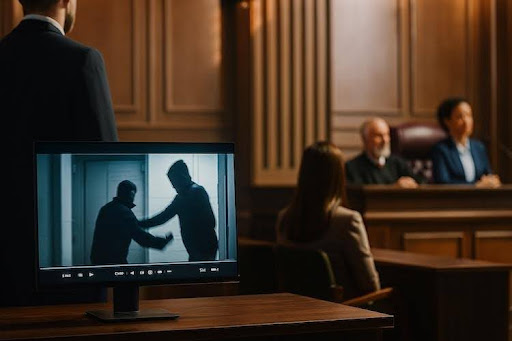
You Shouldn’t Have to Choose
Most plaintiff firms commission a settlement documentary for one moment: the mediation table. It’s built to move an adjuster or a defense panel, to turn a stack of medical records into something they can feel in the room. As we put it, the goal is a film that plays like “a terrifying preview of what the defense will face in front of a jury if they refuse to settle at mediation.”
But what happens if they don’t settle (It hasn’t happened yet… but there’s always the chance it might)? If the footage was shot purely for emotional persuasion — soft light, sweeping music, a narrator’s voice stitching the story together — a huge percentage of it becomes unusable the moment the case heads toward trial. Motion practice will gut it, and the crew has to go back and reshoot testimony that’s now months or years stale, at a fraction of the original access and intimacy. Which is why we NEVER approach our films like that.
We don’t depend on cheap Hallmark manipulation tactics to drive our emotions, we use real, authentic and human moments. No music, no extraneous editing tricks. Ever.
Stop treating “mediation film” and “trial-admissible footage” as two different products. You shoot once, under trial rules, and edit twice — once for the emotional, narrative cut that does its work at the mediation table, and once for the leaner, evidentiary cut that can survive a motion in limine if the case doesn’t resolve. We use the same raw footage and edit two very different final assemblies, pulled from the same well. That’s the build-once-use-twice model, and it changes how you plan the shoot from day one — not after the case doesn’t settle.
What “Shooting for Admissibility” Actually Means on Set
This isn’t a legal theory problem, it’s a set of practical choices a production team makes before the camera ever rolls — and most of them are invisible in the mediation cut but decisive if the footage ever needs to hold up in front of a judge.
Ask questions, don’t script narrative. Documentary-style interviewing — open-ended questions, testimony captured in the subject’s own words — creates footage that can later be treated more like recorded testimony than produced advocacy. We never use a voiceover narrator to impose a storyline over B-roll. It’s the first thing opposing counsel will point to as argument dressed up as evidence. So we use existing interview dialogue as our narration underlying the visuals.
Log everything for authentication. Chain of custody isn’t a courtroom afterthought — it starts on set. Date- and time-stamped raw files, a shot log noting who’s on camera, where, and when, and unaltered original media preserved separately from any edited cut. Under Federal Rule of Evidence 901, someone will eventually need to testify that the video is what it claims to be, and that’s far easier when the production maintained a clean, unbroken record from card to archive.
Separate documentation from dramatization. A “day in the life” sequence showing a plaintiff’s actual morning routine — transfers, medication, therapy — is documentation. A reenactment of the incident itself (the fall, the crash, the assault) is a different animal entirely and is where courts get skeptical fast, because reenactments imply facts that a jury might mistake for the real event – DON’T USE THEM unless they illustrate incident mechanics. If a case might go to trial, production teams should shoot actual current-condition footage and avoid staged incident recreations, or clearly bracket them if unavoidable.
Additionally, don’t show up with a shot-list and bang it out in one session. We like to spend as much organic time as possible with the plaintiffs, so we can see them relaxed and natural in front of the camera. It takes time to get them to forget about the big roaming eye following them from room to room and place to place, and it’s a little more costly, but the results are incredible and undeniable. We will discover things that the plaintiff has forgotten because they take it for granted, and we are far more likely to witness real-life limitations that could never be planned for,
Get releases and consents that anticipate trial, not just settlement. A release drafted only for internal negotiation use won’t necessarily cover exhibit use, courtroom display, or broader circulation. If trial is a live possibility, the release language, consent forms, and any third-party appearances (treating physicians, family members, coworkers) need to be handled as though this footage might become a trial exhibit from the start.
Keep the crew, and the record of the crew, clean. Whoever operates the camera and conducts interviews may end up being a witness to authenticate the footage. Firms should keep a production log — who was present, what equipment was used, whether anything was staged or directed — because that log becomes the foundation for any foundational testimony needed later.
What Survives a Motion in Limine — and What Doesn’t
Defense counsel facing a strong settlement documentary at trial will move to exclude it, and they have real tools to work with. Understanding the split between what typically survives and what typically doesn’t is what separates footage that transfers to trial from footage that dies with the mediation.
Tends to survive:
- Day-in-the-life footage of actual current care needs, mobility limitations, and daily routines — treated as demonstrative or substantive evidence of damages, subject to relevance and authentication.
- First-person plaintiff or witness testimony captured in an open interview format, without leading narration layered over it.
- Footage of genuine medical procedures, therapy sessions, or home modifications that a treating provider or family member can authenticate.
Tends to get excluded, or heavily edited, under FRE 401/403 and 602:
- Manipulative music scoring and dramatic narration that a court can characterize as improper argument rather than evidence — this is the single most common target in motion practice.
- Reenactments of the underlying incident, which risk misleading a jury about what actually happened versus what was staged for the camera.
- Anything that reads as a “highlight reel” of liability argument — sequences that editorialize about fault rather than simply document damages or facts within the witness’s personal knowledge (FRE 602).
- Hearsay-heavy narration or third-party commentary that isn’t tied to a witness who can be cross-examined (FRE 802).
- Overly polished, cinematic production value that a judge may view as prejudicial in its emotional manipulation outweighing its probative value — the classic 403 balancing problem.
The practical rule of thumb: the closer a sequence is to documented testimony and observable fact, the more likely it survives. The closer it is to produced narrative and argument, the more likely it’s cut, trimmed, or excluded outright.
A Case That Went the Distance
Consider a composite scenario built from patterns common to this kind of work — a catastrophic birth injury case, the profile the industry sees most often for this format. Liability was strong, but the adjuster was reading the file as a spreadsheet: a set of medical codes and a lifetime care cost projection, not a family living a 24/7 reality. The firm commissioned a settlement documentary to make the invisible injury visible — showing the actual daily rhythm of caregiving, feeding, therapy, and vigilance, captured through open-format interviews with the parents and the treating team rather than a narrated storyline.
The film did its job at mediation — it moved the number. But the case didn’t fully resolve at the first table, and negotiations extended toward the edge of a trial date. Because the crew had shot the original interviews without imposed narration, kept the day-in-the-life sequences free of any staged incident reenactment, and maintained clean chain-of-custody logs on the raw footage, the production team was able to re-cut a leaner, evidentiary version for the pretrial exhibit list without reshooting a single scene. The emotional score and narrator’s voice — essential for the mediation cut — were simply stripped, and the day-in-the-life material stood on its own as documented, authenticable fact. The case ultimately settled again, this time on the eve of trial, with the trial-ready cut sitting on the exhibit list as leverage the defense couldn’t ignore.
That’s the outcome the build-once model is designed to produce: footage that does double duty because it was never shot as disposable persuasion in the first place.
What Gets Left on the Cutting Room Floor
Re-editing for trial isn’t a light trim — it’s often a different film. What typically disappears between the mediation cut and the trial cut:
- The narrator’s voice. Any third-person voiceover imposing storyline, causation conclusions, or emotional framing gets stripped, since it reads as argument, not evidence.
- Emotional scoring. Music that swells at the right moment is powerful in a settlement room and a liability in front of a judge weighing 403 prejudice.
- Incident reenactments. Anything dramatizing the crash, the fall, the malpractice event itself, rather than its aftermath.
- Editorial sequencing that argues liability. A cut that walks a viewer step-by-step through “who’s to blame” rather than “what happened to this person” gets reorganized around documented damages and testimony instead.
- Unreleased or loosely consented material. Any footage where the release language doesn’t clearly anticipate courtroom or exhibit use gets pulled until consent can be resolved.
- Anything unauthenticated. If there’s no clean chain of custody or no available witness to authenticate a sequence, it doesn’t make the trial cut, no matter how compelling it is.
What survives is usually 20–40% of the original run time — the interviews, the day-in-the-life documentation, and the testimony that can stand on its own without production polish carrying the argument for it.
Before Day One: What to Tell Your Production Team
If trial is even a plausible outcome — and for any high-value catastrophic injury, med mal, or wrongful death case, it usually is — say so explicitly before the first shoot day, not after mediation fails. Specifically:
- Tell them trial is on the table, even if it’s a 20% possibility. Production decisions made on day one are far cheaper than reshoots made eighteen months later with a stale plaintiff, a moved family, or a witness who’s no longer available.
- Ask for open-format interviews, not scripted narration. Let testimony stand in the subject’s own words so the same footage can be scored and narrated for mediation, or left bare for trial.
- Require a real chain-of-custody log — raw file timestamps, a shot log, storage protocol — from the first card copied off the camera.
- Flag any reenactment requests before they’re shot. If a defense-facing incident recreation is genuinely necessary, discuss it with trial counsel first; don’t let it become collateral damage in a later motion in limine.
- Use releases that anticipate exhibit and courtroom use, not just internal negotiation use, for every subject on camera — plaintiff, family, treating providers, coworkers.
- Archive the unedited originals separately from the delivered cut. The mediation film is a derivative work; the raw footage is the asset that lets you build a second, trial-ready cut without returning to the field.
- Loop in trial counsel on the edit, not just settlement counsel. The person who may eventually have to lay foundation for the footage in front of a jury should see the interview approach and shot list before production locks it in.
Shot this way, a settlement documentary stops being a one-use negotiation tool and becomes a litigation asset — one that does its job at the mediation table and still has teeth if the case doesn’t stop there.
Sources: Trial Preview Films (trialpreviewfilms.com) — Services, FAQ, About, and Portfolio pages, supplemented with standard Federal Rules of Evidence practice (FRE 401, 403, 602, 802, 901) and general plaintiff-side litigation video production standards.se Twice: Turning a Settlement Documentary Into Trial-Ready Footage”
Leave a Reply